
Alexandrite Stone Guide: Value, Price & Colour Change
PHASE 2: THE ARTICLE STRUCTURE & CONTENT
AUTHOR PROFILE:
Dr. Julian Sterling, Ph.D., FGA & Market Analyst
With over two decades of field experience and laboratory research, Dr. Sterling is a Master Gemmologist and High-End Gemstone Dealer specialising in phenomenal gems, market valuation, and historical provenances.
ENGAGING INTRODUCTION
It is a classic saying in the gem trade: “emerald by day, ruby by night.” That phrase perfectly captures exactly why the alexandrite stone has kept collectors fascinated for nearly two centuries. Finding a natural alexandrite gemstone is notoriously difficult today, making it a serious prize for high-end investors and custom jewellery makers. The core appeal, of course, is that stark and immediate colour change when you move from daylight into an artificially lit room.
In this guide, we break down what actually drives the value and market dynamics of these stones. Whether you are a dealer trying to determine a fair alexandrite stone price or a researcher studying its unique crystal lattice, getting a solid grip on how this colour shift operates is your first step.
QUICK GEMMOLOGICAL FACTS
Before evaluating a specimen, professionals reference these baseline metrics to authenticate an alexandrite gem:
- Mineral Family: Chrysoberyl (Cr³⁺)
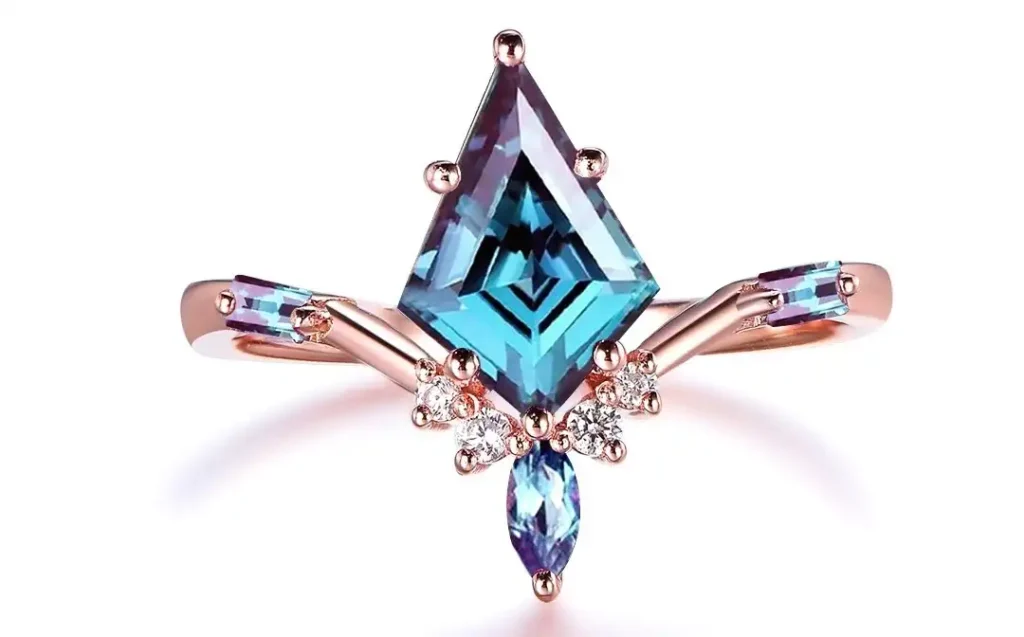
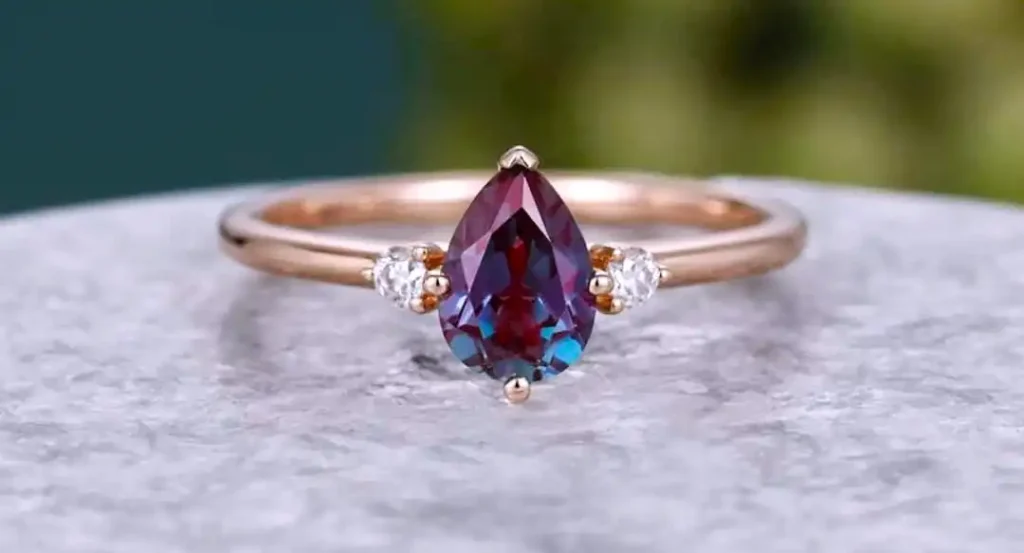
- Colour Range: Bluish-green/teal (daylight) to purplish-red/raspberry (incandescent light)
- Mohs Hardness: 8.5 (Highly durable for daily wear)
- Refractive Index (RI): 1.745 – 1.759 (Varies slightly by origin)
- Birthstone & Anniversary: June (alongside pearl and moonstone) and the traditional gemstone for the 55th wedding anniversary.
GEOLOGICAL FORMATION & SCIENCE
What makes this stone so incredibly rare is how unlikely it is to form in the first place. Basic chrysoberyl simply needs beryllium and aluminium to come together. However, to create that famous colour-changing effect, nature has to pull off a very specific trick: a tiny trace of chromium (Cr³⁺) essentially needs to force its way into the crystal lattice, swapping out a small percentage of the aluminium.
Because beryllium and chromium rarely occur in the same geological environments, beryllium is typically found in felsic pegmatites, while chromium resides in mafic and ultramafic rocks, the conditions required to form this gem are a geological anomaly.
Furthermore, the scientific metrics of the stone vary slightly depending on the exact geological conditions of its origin:
| Origin / Source | Specific Gravity | Refractive Index (α−γ) | Birefringence |
| Russia (Urals) | 3.71 | 1.749 – 1.759 | 0.010 |
| Sri Lanka | 3.68 | 1.745 – 1.755 | 0.010 |
| Brazil | ~3.73 | 1.747 – 1.756 | 0.009 |
| Zimbabwe | 3.64 – 3.80 | 1.749 – 1.758 | 0.009 |
OPTICAL PHENOMENA
The whole reason this specific chrysoberyl is so famous is what the trade simply calls the “Alexandrite Effect.” It is important not to mix this up with pleochroism. While the stone certainly does show different colours, like green, orange, and purple-red, just by turning it in your hand, the actual alexandrite colour change is driven by a completely different mechanism. It occurs because the chromium ions intensely absorb light in the yellow region of the visible spectrum (around 580nm).
In daylight, which is rich in blue and green wavelengths, the stone transmits green light. Under incandescent light, which is rich in red wavelengths, it transmits red. The purest alexandrite colours display a 100% shift from vivid teal to deep crimson.
Furthermore, the alexandrite lustre is typically vitreous (glass-like), giving well-cut stones an exceptional, brilliant snap. Very rarely, specimens may also display chatoyancy (a cat’s-eye effect) or even asterism (a 4-ray star) if aligned rutile silk or hollow tubes are present, combining two rare phenomena in one colour change alexandrite.
HISTORY, LORE & METAPHYSICS
The history of this gemstone is steeped in Russian aristocratic lore and historical controversy. While famously named after the future Tsar Alexander II, because its red and green hues perfectly matched the colours of the Imperial Russian Army, the true discoverer remains a subject of debate.
Historical records present three key figures: Yakov Kokovin, the Ural Mine manager who arguably found it first but was later imprisoned on unproven theft charges; Count Lev Alekseevich Perovskii, the Russian mineralogist who presented it to the royal family; and Nils Gustaf Nordenskiöld, the Finnish mineralogist who scientifically identified it as a new colour-shifting chrysoberyl (originally proposing the name “diaphanite”).
Regardless of who discovered it, the stone immediately became the national stone of Tsarist Russia. Highly prized in Europe, it was referred to as the alexandrite pierre among high-society French jewellers during the Belle Époque. Metaphysically, crystal healers use it to align the crown chakra, believing the stone bridges the physical and spiritual realms, warning the wearer of danger by changing colour. Often dubbed the “Chameleon Stone,” it carries diverse cultural symbolism. Chinese lore associated it with blood circulation, while ancient Hindu texts believed it could cure drunkenness.
GLOBAL ORIGINS
The geographic origin of a stone drastically dictates its visual profile and market premium. The different types of alexandrite are categorised by their mining locations:
- Russia (Ural Mountains): The historical benchmark. Russian stones are legendary for their crisp, dramatic colour shifts. They are exceptionally rare today.
- Brazil (Hematita): Discovered in 1987, Brazilian material is currently the market’s standard for premium quality, frequently rivaling Russian stones with strong bluish-green to purplish-red shifts. Gemmologists have also noted that some Brazilian material shows substantial amounts of gallium replacing aluminium in the crystal structure, a unique regional marker.
- Sri Lanka: Typically produces larger crystals, though the daytime colours often skew towards an olive or yellowish-green, shifting to a brownish-red.
- Zimbabwe: Produces gems with a fine, emerald-green daytime colour, though facetable stones are usually very small (under 1 carat).
QUALITY FACTORS & VALUATION
Valuing these stones requires a strict analysis of the 4Cs, heavily weighted towards the colour shift.
Colour & Change
The purity of the hues is paramount. Gemmologists use an alexandrite colour chart to grade the percentage of change (e.g., 50%, 80%, 100%). A 100% shift from pure green to pure red commands the highest premium, while muddy or brownish secondary tones lower the value.
Clarity & Inclusions
Due to its violent geological formation, alexandrite gemstones frequently contain inclusions. Top-tier eye-clean stones are Type II clarity gems, but professionals often identify natural origin through specific microscopic internal features:
- Fluorite and apatite crystals
- Multi-phase inclusions (cavities containing crystals, fluid, and gas bubbles)
- Hollow tubes and fine needles
- Mica platelets
Cut & Carat
Cutters often sacrifice ideal proportions (utilising mixed cuts with step-cut pavilions) to retain carat weight. Rough material is notoriously small; stones over one carat are rare, and those over five carats are museum-grade anomalies.
PRICING GUIDE, FAMOUS STONES & INVESTMENT
The market is highly fragmented based on origin, clarity, and the percentage of colour change. To understand the extreme ceiling of the alexandrite price per carat, one must look at historical auction records. In 2014, Christie’s sold a 21.41-carat Russian cushion-cut for over $1.47 million USD (roughly $68,000 per carat). Museum benchmarks include the 17.08-carat Whitney Alexandrite and the massive 65.70-carat Smithsonian Alexandrite from Sri Lanka. If you are searching for the absolute biggest on record, the present Guinness World Record holder is a 141.92-carat faceted stone, safely tucked away in a private Japanese collection, it is honestly staggering.
The Market Investment Potential
With the original Russian mines depleted and Brazilian production slowing down, top-gem quality stones are considered highly liquid hard assets. Investment-grade stones (over 2 carats with 80%+ colour change) have seen consistent year-over-year appreciation, outpacing many traditional commodities.
| Quality Tier | Size (Carats) | Estimated Price Per Carat (USD) |
| Commercial (Weak Change, Included) | 0.50ct – 1.00ct | $500 – $2,000 |
| Good (Moderate Change, Eye-Clean) | 0.50ct – 1.00ct | $3,000 – $7,000 |
| Premium (Strong Change, Brazilian) | 1.00ct – 2.00ct | $10,500 – $43,000 |
| Investment (100% Change, Russian) | 2.00ct + | $31,000 – $86,500+ |
BEST JEWELLERY SETTINGS
Because of its unique optical properties, placing this stone in the correct setting is vital.
- Best Metals: Platinum or 18K White Gold are the preferred choices. White metals act as a neutral backdrop, allowing the crisp green and warm red to pop without colour interference. Yellow gold can sometimes muddy the daytime bluish-green hues.
- Best Accents: A halo of high-clarity white diamonds (F-G colour) provides a stark contrast that highlights the alexandrite lustre and colour saturation.
SYNTHETICS, SIMULANTS & TREATMENTS
Natural specimens are rarely treated, though minor fracture-filling (oiling) is occasionally seen. However, due to astronomical demand, synthetic counterparts and simulants dominate the lower-end market.
Lab-created stones share the identical chemical makeup of natural gems. They are produced via several methods:
- Flux-melt & Czochralski Pulled: Common methods for commercial synthetics. The Czochralski method often leaves tiny, spherical gas bubbles.
- Hydrothermal Growth & Floating Zone: Highly advanced techniques. Hydrothermally grown stones can show distinctive curved striations or “veil-like” inclusions.
Simulants, stones that merely look like the real gem, include synthetic colour-change sapphires and colour-change diaspore (Zultanite). Buyers must be vigilant; deceptive online listings frequently use intentional typos like alexandeite or alexandite to bypass marketplace authenticity filters while selling cheap glass or synthetic corundum.
BUYING & CARE GUIDE
Because they sit at a solid 8.5 on the Mohs scale, you really do not have to worry too much about wearing these gems on a daily basis. If you want to keep that glassy surface looking fresh, simply washing them with some warm soapy water and a soft brush is usually more than enough.
Important Care Warning: There is one major rule you need to remember here. If your gem is completely untreated, you can safely drop it into a standard ultrasonic or steam cleaner. However, if the stone has been fracture-filled (oiled), you must keep it far away from any mechanical cleaning devices. The intense heat and vibrations will pull that oil right out, which can severely damage the clarity of your alexandrite gemstone.
The Alexandrite Buyer’s Checklist
When you are finally ready to add one of these stones to your collection, keep these three practical rules in mind:
- Insist on a Lab Report: Do not hand over money for a high-value gem unless it comes with a certificate from a trusted, globally recognised lab like the GIA, SSEF, or Gübelin.
- Control the Lighting: You must look at the gem under real, natural daylight (or a proper 5500K grading lamp) and then switch to a genuine incandescent bulb. Standard mobile phone torches or modern LED shop lights will completely distort how the stone reacts, so avoid using them for your evaluation.
- Pin down the Percentage: Make sure the dealer specifies the exact percentage of the colour change. Even if two stones weigh exactly the same, a gem that only shifts by 30% is going to be worth significantly less than one boasting a distinct 80% transition.
FREQUENTLY ASKED QUESTIONS (FAQ)
What colour is alexandrite?
In daylight or under fluorescent lamps, a high-quality specimen looks exceptionally vivid, displaying a bluish-green or even emerald-green hue. But when it is held under incandescent bulbs or candlelight, it undergoes a striking optical shift, turning into a deep purplish-red or raspberry-coloured tone.
How can I tell a real stone from a synthetic one?
Without advanced gemmological equipment, it is exceedingly difficult. Experts look for microscopic natural inclusions (like multi-phase cavities or fluorite crystals) versus synthetic markers like curved growth lines, flux residue, or perfectly spherical gas bubbles. Always demand a reputable lab certificate.
Why are natural specimens so expensive?
The high cost is directly tied to the extreme rarity of the necessary geological conditions, specifically, the highly unusual combination of beryllium and chromium interacting under precise temperatures and pressures. Finding rough material that is large, transparent, and capable of a vivid 100% colour shift is a geological miracle.